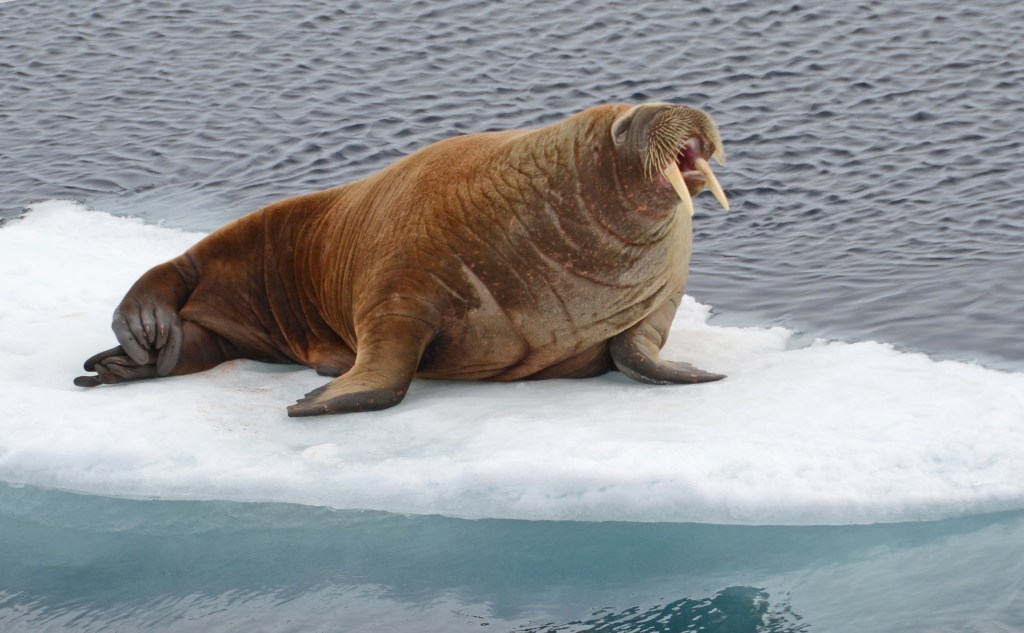
This week a story hit the news that was both fascinating and thought-provoking. The story was about a walrus who washed up on the shore of Valentia Island, an Irish island off the coast of, you guessed it, Ireland. This was the first-known sighting of a walrus in the wild in that country and it caused quite a stir. Marine biologists believe that the big blubbery boy fell asleep upon an iceberg in the North Pole and while he slept the berg drifted south, until it hit the Irish coast. When he awoke he found himself in unfamiliar surroundings, presumably against his will.
I’ve thought a lot about this story all week and how it applies to my life. Sometimes it feels as though I’m content to just drift along. I fall asleep on some comfortable iceberg and next thing you know I am somewhere completely different than I ever anticipated. It’s actually the very easiest thing to do.
For most of known history it wasn’t actually necessary for most people to have to make big decisions. You attended the state-mandated church; in society the lower classes worked the fields or shops in line with many generations of their forebearers while the upper classes followed the strict laws of primogeniture, including set roles for the younger sons; women married and bore children or became maiden aunts to tend to their siblings’ children. Small day-to-day matters allowed choice, but most large matters were proscribed by external forces. On occasion individuals broke free of those restrictions, but by and large the rules held, and life continued in a fairly predetermined manner.
With the advent of the Reformation beginning in 1517 people began having to make choices of a larger nature than before. Suddenly people had to decide whether to follow reformers or the state religion. There were consequences to both, and sometimes it was a gamble to figure out which way the political winds were blowing if you wanted to literally survive. The Reformation led to colonization of New England, and the North American colonies, especially post-Puritan governance, allowed for wider opportunities on all fronts, leaving behind the archaic laws that required lock-step behaviors. In the 17th and 18th centuries came the Age of Enlightenment and the wider exploration of individual liberties. As education became more universal, as nations adapted and adopted semi-democratic governments, and as transportation and communication opened the floodgates to increased knowledge about the limitless opportunities afforded people throughout the world, then the responsibility to make responsible life choices became more critical.
In 1838 Henry Wadsworth Longfellow wrote:
Tell me not, in mournful numbers,
Life is but an empty dream!
For the soul is dead that slumbers,
And things are not what they seem.Life is real! Life is earnest!
And the grave is not its goal;
Dust thou art, to dust returnest,
Was not spoken of the soul.Not enjoyment, and not sorrow,
Is our destined end or way;
But to act, that each to-morrow
Find us farther than to-day.Art is long, and Time is fleeting,
And our hearts, though stout and brave,
Still, like muffled drums, are beating
Funeral marches to the grave.In the world’s broad field of battle,
In the bivouac of Life,
Be not like dumb, driven cattle!
Be a hero in the strife!Trust no Future, howe’er pleasant!
Let the dead Past bury its dead!
Act,— act in the living Present!
Heart within, and God o’erhead!Lives of great men all remind us
We can make our lives sublime,
And, departing, leave behind us
Footprints on the sands of time;Footprints, that perhaps another,
Sailing o’er life’s solemn main,
A forlorn and shipwrecked brother,
Seeing, shall take heart again.Let us, then, be up and doing,
With a heart for any fate;
Still achieving, still pursuing,
Learn to labor and to wait.
It’s a beautiful and inspiring sentiment, but the question becomes, how do we go about stopping the drift and actively seek to control our own destinies? What stops us from doing so when we know that drifting, while easier, is so less satisfying?
I’m going to answer the last question first. For me, I tend to be stopped by fear. Plain and simple, fear keeps me from making the big decisions. Like Alice, while speaking to the Cheshire Cat, I like to ask directions without having an end in mind. I’m afraid of making the wrong choice. I’m afraid of failure. I’m afraid of annoying people or making a fool of myself. There are innumerable ways to fear. And yet, as we read from the Apostle Paul in 2 Timothy, “God has not given us the spirit of fear, but of power, and of love, and of a sound mind.”
Another hindrance for me is feeling that I don’t have enough information to make the big decisions. And yet James tells us that if we will but ask God, with sincere intent, that He will make things manifest to us. It’s not like I haven’t seen this work, either. Repeatedly throughout my life I discover that when I pray and seek guidance and then move forward that things will somehow always work out in the Lord’s time and quite possibly in a different way than I envisioned.
Ben graduated with a BA in filmmaking from USC with a dream of impacting the world for good and yet when he passed away, he wasn’t a filmmaker, but a successful corporate litigation attorney who had successfully argued a precedent-setting case on state’s rights before the Ninth Circuit Court of Appeals. His career path wasn’t a straight line but looking backwards we could see how God had led every step of the way, even when it seemed that we had no clue what we were doing. We were often amazed at how the Lord answered in unique, but perfect, ways. There was no doubt that by seeking a direction to pursue, pursuing that direction, and continuing to make sure we were on the right path was key to success.
So here I am, having to make a choice. Am I going to be a walrus drifting on an iceberg controlled by external currents, or am I going to be proactive in finding the path that is right for me? There is so much I want to do, so many battles I want to fight, and so many dreams I want to fulfill. Will I end my days, as John Greenleaf Whittier said, with the regretful words, “it might have been,” or will I chart the course of my own destiny and, to paraphrase (and even butcher) the words of Alfred, Lord Tennyson, trust that “it is better to have [tried] and lost than never to have [tried] at all.”
Will I be a walrus or the architect of my own fate? I think I’ll take up architecture.

 Look to God and Live... Joyfully!