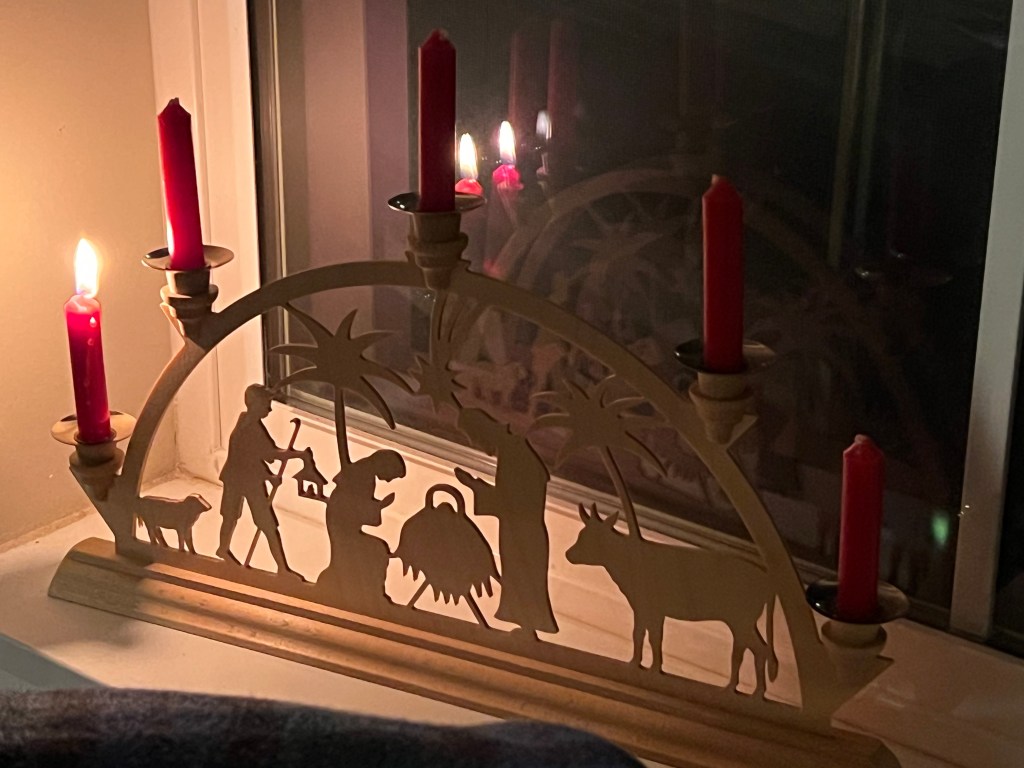
Today is the first Sunday of Advent. Thanksgiving is my favorite holiday, probably partly because it is the gateway to the wonderful Christmas season. I love the music and overall feeling of this time of year. Can you blame me? As I’m writing this I’m listening to music by Leslie Bricusse from his show Scrooge and getting all emotional. It really is such a great season!
Anyway, getting back to Advent…
I always associated the word advent with the cute homemade calendar we used every year to countdown the days in December until Christmas, and indeed that is a popular form. But the term advent is actually translated from the Greek word parousia, which in the New Testament is used to speak of the Lord’s Second Coming. In Western Christianity the tradition of honoring advent by looking back at Christ’s holy birth in Bethlehem, looking inward at the personal reception of Christ in individual lives, and then looking forward to His second coming is much deeper and richer and has more meaning in my personal life than just focusing on the Babe in the manger.
No one really knows when the trifold purpose of advent really began, but scholars believe that a form of advent originated in the fifth century. I won’t go into the full history, but it really is interesting. Be grateful that we celebrate the way we do instead of fasting three to seven days a week for four weeks! Anyway, if you’re interested in learning more just let me know and I can direct you to some sources.
I first really became acquainted with the beauty of the advent tradition about a year or so ago. I made it a priority to obtain an advent wreath and begin my own personal worship of Christ and self-analysis of where I stand in my relationship with Him in a more formal way during the season. I don’t have much room for a wreath, however, and was pleased when I found a beautiful Polish handmade advent nativity in Wittenberg, Germany earlier this year. I can’t wait to light the first candle in a few minutes!
In many churches the four weeks before Christmas have a prescribed script of themes to focus on in church services. The order of topics is different according to the religious tradition, but the topics themselves seem to be the same (as far as I can find). Those topics are hope, preparation, joy, and love – followed by adoration as the subject for Christmas Eve. For the next few weeks I’m going to be focusing on these topics as I enjoy the worship of the glorious advent period.
Hope. I love this word. Hope bespeaks eager anticipation and belief in the thing yearned for. I have hope that someday Toby will be fully trained. I look with hope for the day I find the perfect job. I am filled with hope for my next trip (to Italy this time). I have hope for my sports teams to succeed. There is much in life to hope for. But the hope of advent is deeper than these.
The Old Testament is replete with words of prophets foretelling the birth of Jesus Christ. Just listen to Part I of Handel’s Messiah to get a flavor of the prophecies. These prophets spoke with authority about the need for us all to be rescued from the dark night of eternal pain that came from the Fall of Adam and Eve. These prophets then followed up the dire words of need with the promise that rescuing would indeed occur thanks to the coming of the Son of God, the Savior of the World. Because of those promises humankind was able to live with hope that they would not be cast off and lost forever. Of all things to hope for, that seems like a powerful one.
Christ indeed came. He fulfilled the promises spoken of, and the hope of many generations of the faithful came to fruition as He took upon Him the sins and pains of all and then overcame death. But the suffering borne for us and the glorious resurrection are still only part of the work of the Savior. There is yet another coming to hope for, when all things will be made whole.
It is this hope that the New Testament is filled with. Christ, and subsequently His apostles, spoke in anticipation of Christ’s second coming and the hope for the day when all wrongs would be made right, all hurts would be healed, and all pain would cease. While the quip I learned growing up that “time wounds all heals” is a fun momentarily comforting thought, the truth is I’m more worried about time healing all wounds. This is a powerful motivator. Having hope for that day helps put day-to-day issues in their proper place and perspective.
Romans 13 is used during the Hope Week of advent as a guide for how to be worthy of maintaining hope in Christ. In essence, Paul tells the Romans to love one another, for in that they have fulfilled the law. If one has love for one another then they will not commit the sins that drive wedges between people. It is love that casts out sin and therefore allows us to place our hope in the perfect day of Christ’s coming. Often people focus on some of the more nitpicking and culturally focused writings of Paul (including some possible mistranslations that have become widely accepted), but in reality Paul is always talking about cleansing our inward vessels and becoming purified so that we are able to receive Christ. We are not supposed to cleanse anyone else’s vessel and force them to be purified – only ourselves. Christ loves us where we are and He asks us to do the same for others.
As I light my advent candle tonight I will be thinking about the hope that comes through Christ. It’s a good week for that. This week would be Ben’s and my 30th anniversary. I live with hope for when I get to see him again and enjoy being with him. As I put up my nativities this week I will look at each piece with a sense of wonder that God would send His beloved Son to rescue me and I will look forward with an eye of hope for the day when all wars will cease and peace will cover all the earth. Life can be hard, but with hope life becomes bearable and beautiful.
Hope: It’s a wonderful gift of Christmas.

 Look to God and Live... Joyfully!