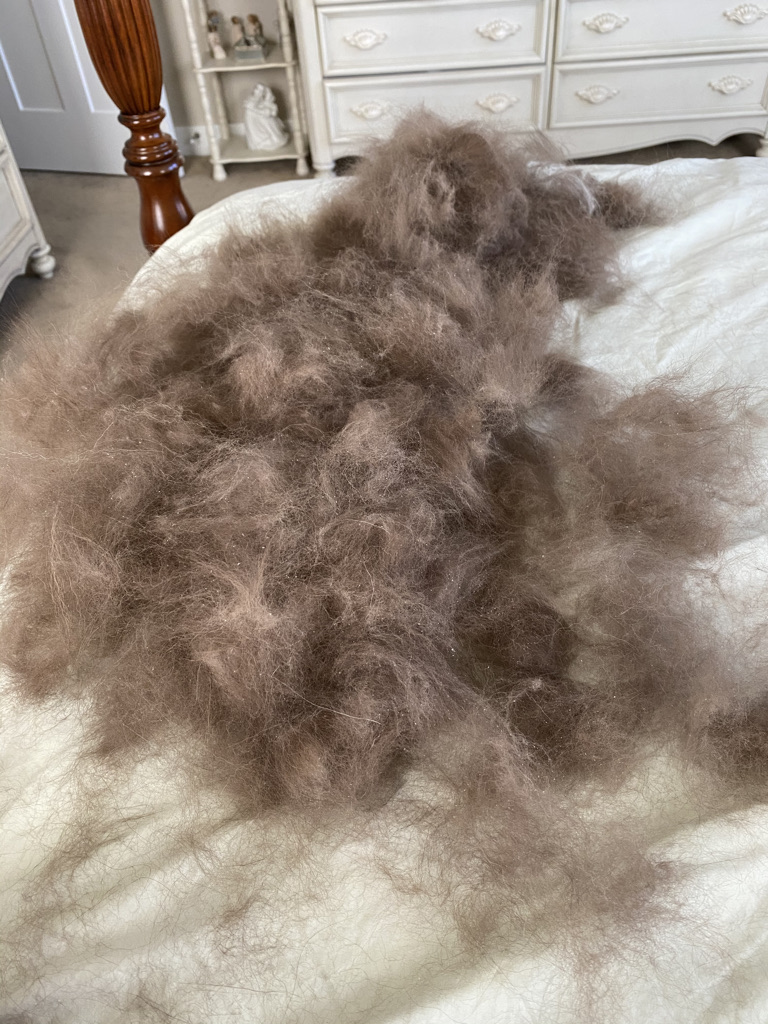
The other day I decided that it was time to brush my dog Sunny. Now, Sunny is a Mini Australian Shepherd and has a lot of hair for a dog so small. I was tired of finding her hair all over the house, so I decided to give her a thorough brushing. I brushed and brushed and brushed and the pile of hair being shed kept growing. I’d think one section was finished and would begin another only to come back to the previous area to find more hair waiting to be come out. I spent about an hour and accumulated what seemed like two dog’s worth of hair. A few days later, when dog hair began reappearing around the house, I brushed her again and had more hair piled up. Naturally poor Sunny became an analogy for life as I thought about how Sunny’s fur wasn’t that different from my own life. Surely I have layers upon layers of difficult emotions and habits that are waiting to be removed, and the more I work to shed myself of them the more I discover there are. I have discovered that I’m not alone in this.
I recently read a post on social media. A widower of a couple years commented that he was sitting in a meeting about genealogy when all of a sudden he was hit by a wall of grief and longing for his wife. As widows it’s easy to think, when we’re in a happy place, that the worst of the pain is behind us, but the reality is that we are never really past the loss of a loved one. Loss is hard and the layers of grief cannot be underscored enough. Allowing ourselves to grieve, for however long, is something that we need to give permission to ourselves and others to experience. I talked to a man recently who was widowed nearly 30 years ago. He remarried and is very happy in this second marriage. However he still, as he told me, has days when he hurts and misses his first wife. It’s natural and is never something to be embarrassed about. Grief is indeed a multi-layered emotion that requires patience and acceptance.
I talked to a friend recently who has dealt with years of emotional abuse in her marriage. She is now a caregiver and as she faces the inevitable end of her spouse’s life she has mostly come to terms with her painful experience. She works hard to not allow the situation she has been in to color her view of her own worth, but it doesn’t always work. She has days – and even weeks – where she struggles with the pain of it all. “I think I’ve mastered it,” she said, “but then it just sneaks up on me and I can’t seem to control my emotions. I hate myself – first for deserving this treatment and second for feeling self-pity. I intellectually know that that I did nothing to deserve this, and I also know that it’s okay for me to struggle, but it’s hard when I thought I had reached a good place with it all.” Layers of pain, still there and still needing to be combed out.
I personally struggle with poor self-esteem and social anxiety stemming from the circumstances that led to my feelings of insecurity. Most of the time I have found that people are generally kind and that there really isn’t anything to fear in my interactions with them, but that isn’t always the case and when I really struggle when I am in a situation that doesn’t feel emotionally safe. Years ago, for example, there was someone who regularly said unkind things every single time I was in her presence. I tried so hard not to take it personally, but when the comments were about my talents (or lack thereof), my parenting, my appearance, or my basic life skills it became difficult to pretend they weren’t meant in a very personal way. Have I mentioned that I struggle with feelings of inadequacy and poor self-esteem? Anyway, my way of dealing with this kind of situation is always to erect a huge wall and then act cold. I hate that response in myself. As a typically warm personality, feeling isolated enough to act cold and aloof stands out and sends a message of hate, which I don’t want to send, and so whenever possible I just try to avoid those situations where I know I’m going to respond this way. Unfortunately I was unable to avoid being around this person at times, and so I would pray hard in advance of dealing with them that I somehow just wouldn’t “misbehave.” I prayed and prayed and prayed. Then we’d go where this person was and immediately my wall went up and I acted cold. Immediately. Like even before they said anything to me. Oh, I hated myself for this! I learned, however, that pain is rooted in complex ground and that I can’t just will myself to change. I finally found the courage to avoid the situation altogether, but the pain unfortunately remained. I discovered that you can’t shed your unwanted layers just by wishing, or praying, them away. Instead, these layers need to be worked through with patience and forgiveness of the other person and of yourself.
I have many other examples I could cite of the complexity of life. The times I vow to never commit a certain sin again, only to fall at the first opportunity. The times I vow not to panic about future unknowns or feel hurt by people in situations outside of my control or to follow through on things I need to do but keep putting off or to break down in feelings of grief and loneliness. None of these are simplistic one-dimensional issues and none are simplistically fixed.
Years ago I talked to someone who was struggling with depression and feelings of inadequacy. In an effort to help them remove the crushing guilt they felt for having these feelings – and the mental and emotional paralysis that always accompanied this guilt – I explained to them that people were like PCs: there are so many unrecognized processes working in the background that we don’t always have control over our reactions. I remember learning that my PC would frequently crash because there were hidden programs or something (I’m really not computer literate. That’s why I now use MACs) constantly running behind the scenes slowing things down, affecting the program I was trying to use, or impacting the basic health of my system. It took a pro to look at the computer and figure out what was happening and try to fix the problem. Sometimes it worked and sometimes it was only a temporary solution. I believe that we really are like that. Our baggage of mental and physical health, a lifetime of experiences, individual personalities, and other factors have more impact than we like to think. It’s ridiculous to beat ourselves up for things that we cannot and do not understand.
One of the most glorious things about God is that He is patient with us. He understands all these issues that we don’t recognize in ourselves. He embodies the fruits of the spirit, for He is their source: love, joy, peace, patience, kindness, goodness, faithfulness, gentleness, and self-control. He doesn’t ask or demand perfection, only a willing and loving heart. Only through Him can we effectively work through our layers of imperfection and struggles and find peace. It might not be immediate and it might never be here on earth, but with faith and hope in Him we can ultimately triumph. Just look at the Apostle Peter. His repeated failings are recorded in the scriptures, but God still used Him to fulfill His purposes. Peter kept growing, even though he continued struggling (read the Book of Acts, if you need more proof). God never gave up on this great man, and He never gives up on us.
In the wonderful book Pilgrim’s Progress, John Bunyan tells the story of Christian – a newly converted individual who is undertaking a journey from the City of Destruction to the Celestial City on Mount Zion. He carries a large burden upon his back, representing sin. What a feeling of relief when he is able to drop his burden into the open sepulcher of Christ! Along his path Christian occasionally wanders off the path, such as into the Slough of Despond or into the worldly city of Vanity Fair, but always finds his way back. Despite his lapses, Christian ultimately arrives at the gates of the Celestial City where he is welcomed with wide-open loving arms.
It is sometimes hard to remember that, as Milton said, “God needs not man’s work or his own gifts…” What God requires is the willingness to pursue the path, even though we sit down at times or even wander off. What God requires is our love. He is willing to comb out our layers to get to the beauty underneath.
I had a great-grandfather who was addicted to tobacco, even though he belonged to a faith where such a thing was anathema. But Great grandpa loved the Lord and he showed it in the service he gave. He wanted to overcome his addiction but couldn’t: for some people addiction recovery is easier than for others. Despite his addiction, however, I am sure that the Lord welcomed Him with open arms when he reached those heavenly gates. God sees far more than we can ever see in ourselves.
When I start to beat myself up for an unexpected day of debilitating grief or unwanted social anxiety or unwelcomed panic or a relapse of sins I thought behind me, I need to remember that I am still a young plant, stretching and growing and setting down my eternal roots. I am not a simplistic being, but an individual with layer upon layer of issues to be combed out so that I can be exalted, beautified, and changed. God is love, as John said, and with that love He allows us to grow at our own pace and in our own way. He understands – and He cares. “What a friend we have in Jesus,” the song says. God is willing to comb through our layers time after time, helping us shed the natural man for the new man that is underneath.
I have combed Sunny multiple times since that initial brushing. Each time there is more hair shed. In between times there is hair on the floors of my house. Each brushing, though, gets easier and the sheer volume of hair shed is less. I know that I, too, will continue needing the patience of the Lord as He brushes away the layers of my weaknesses. I’m grateful that He is willing to do so.


